
Why Lights-Out Manufacturing is the New Standard for On-Time Delivery
100% of a product’s delivery success depends on its production continuity. Let’s take a fabrication facility at 2:00 AM. The lights are off, and the building is silent, yet the floor is alive with activity. Thousands of watts of fiber laser power are slicing through sheet metal with surgical precision, while automated towers swap out heavy raw material sheets for finished parts without a single human hand touching the machine.
This is lights-out manufacturing. While the term might sound like a futuristic concept, it’s the operational standard that keeps our customers’ most critical launches on schedule. Unmanned production has evolved from a simple efficiency gain into a powerful form of risk mitigation.
What is Lights-Out vs. Basic Automation?
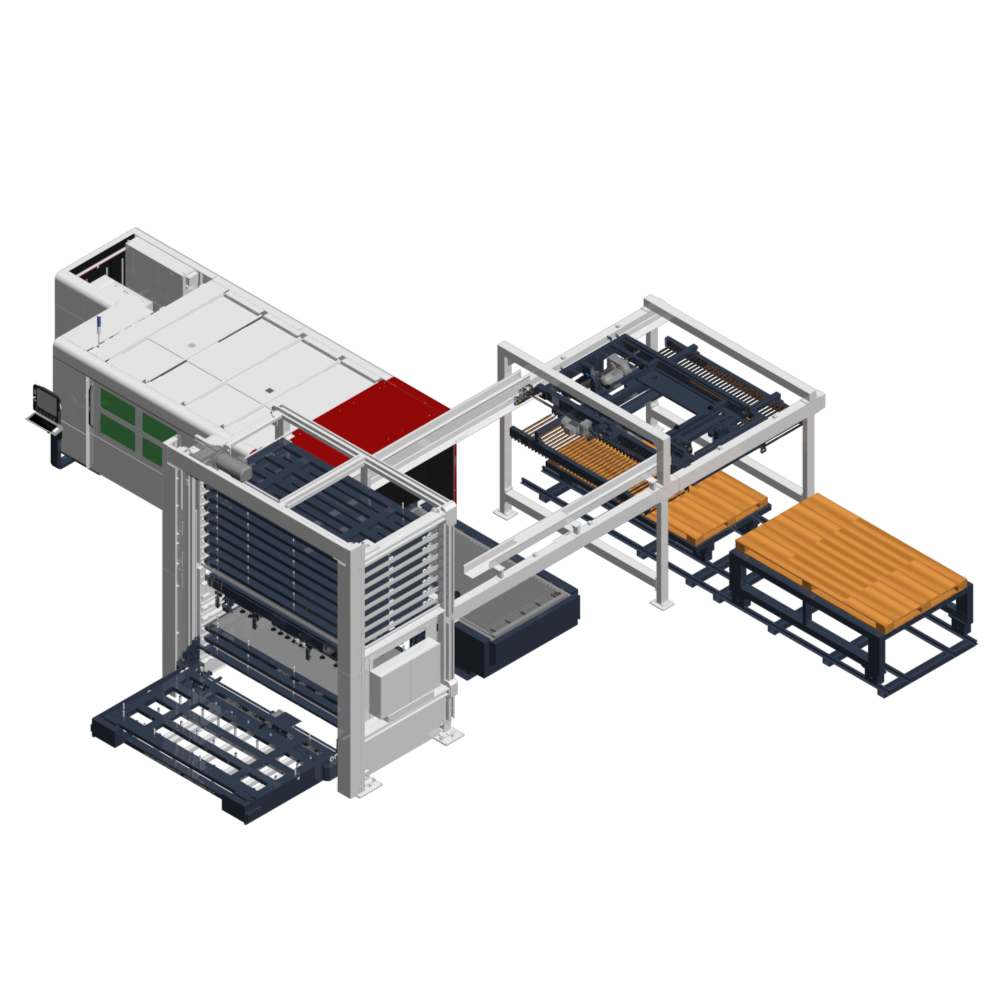
Many fabrication shops claim to offer automation, but there is a significant technical gap between a standalone machine and a true Flexible Manufacturing System (FMS).
Basic automation often consists of a laser equipped with a simple pallet changer. While this allows a machine to swap sheets more quickly than a manual operator, it still requires human intervention to load raw material and clear the station.
In contrast, our lights-out capability is powered by SmartFlex Rapid Towers. These vertical warehouses can store hundreds of sheets of varying gauges and alloys, automatically cycling them into the laser based on the production queue. This transition from human material handling to AI-driven management allows for truly autonomous, multi-day runs that don't pause when the sun goes down.
How Lights-Out Production Protects the OEM’s Schedule
Traditional fabrication is inherently limited by the 8-hour day. When a shop is running at 100% capacity during daylight hours, they have zero margin for error. If a machine goes down or a staff member calls in sick, the schedule slips immediately. Lights-out manufacturing provides four specific layers of protection against these issues.
1. Eliminating the "Labor Bottleneck"
The manufacturing industry continues to face significant volatility in the labor market. By decoupling capacity from human headcount, lights out manufacturing means that your production isn't sidelined by staffing shortages or overtime limits. While competitors are restricted by how many operators they can put on a shift, our automated systems provide a consistent, predictable output that remains unaffected by the human variables of the traditional workday.
2. The Built-In Capacity Buffer
Think of lights-out manufacturing as a 3rd shift that doesn't require a paycheck. By utilizing the 16 hours of non-working time every night, we create a massive productive buffer. This allows us to handle sudden volume spikes or hot prototypes without delaying your existing standard production runs. If a project requires an emergency mid-week adjustment, we have the dark hours available to absorb that extra workload, keeping your primary deadline intact.
3. Consistency Through AI-Driven Monitoring
A common fear of unmanned production is the basket of scrap or the idea of a machine failing at midnight and running bad parts until morning. Modern lights-out systems prevent this through real-time AI monitoring and part verification. These systems monitor beam stability, nozzle condition, and material alignment. If a defect is detected or a tip crash occurs, the system reacts immediately to pause the run or skip to the next sheet, protecting your material and maintaining quality even without a pair of eyes on the machine.
4. Optimized Nesting and Throughput
In a manual environment, high-mix nesting (mixing many different parts on one sheet) can be labor-intensive and prone to sorting errors. Our FMS software handles complex, high-mix nests overnight with a level of precision that is difficult to achieve manually. This maximizes material utilization (reducing your raw material costs) and ensures that even smaller, complex components move through the facility with the same priority as high-volume orders.
The "Quiet" Financial Benefit: Predictive Pricing
While the most immediate benefit of lights-out manufacturing is speed, the long-term advantage for OEMs is financial stability. Traditional manufacturing costs are often volatile, fluctuating based on overtime labor rates and the inefficiencies of single-shift operation. By transitioning to a 24/7 utilization model, the cost per hour of our high-performance machinery is significantly lowered. Because we are able to spread the fixed costs of the equipment over a much larger volume of parts produced in the dark hours, we can pass those efficiencies on to you in the form of more competitive and, more importantly, stable pricing.
Beyond the machine hours, there is a secondary sustainability and cost benefit found in the dark of the factory. Operating unmanned allows us to drastically reduce the energy requirements of the facility. Machines don't require high-intensity overhead lighting or the aggressive HVAC temperature control that human teams need to remain comfortable. These reduced overhead costs further insulate our pricing from the energy volatility that often hits traditional manufacturers, providing you with a more predictable budget for long-term production runs.
Is Your Part a Candidate for Lights-Out?

Automation is a powerful tool, but it is most effective when paired with the right types of projects. To maximize the benefits of our FMS and SmartFlex Rapid Towers, we look for parts that meet specific criteria for unmanned stability. If your project fits the following checklist, it is likely an ideal candidate for our lights-out productivity buffer:
Mature Designs with Stable Tolerances: Because the system runs without manual intervention, parts with proven designs and established, repeatable tolerances are the most reliable for overnight runs.
Standard Material Gauges: Our towers are optimized to cycle standard sheet sizes and gauges of mild steel, stainless steel, and aluminum.
High-Volume Runs or Part Families: Projects that require high quantities or families of different parts that can be nested together on common materials allow the FMS to fully flex its muscle in material efficiency and uninterrupted throughput.
Contact HPM to ensure the right technology is applied to your project.
Partnering with the Future of Fabrication
The transition to AI-driven material management and 24/7 autonomous production is a commitment to protecting our partners from the uncertainties of the modern market.
We recognize that being a reliable partner means proactively solving for capacity before it becomes a problem. By investing in early adoption of advanced engineering and automation, we fabricate your parts even while your own team is offline, giving you a head start on every business day.
While others are forced to navigate the limitations of the standard workday, HPM utilizes a resourceful and principled approach to manufacturing that turns time into a competitive advantage for our clients.
Does your current fabrication partner have a 24/7 plan for your project? Request a quote today to see how HPM’s automated throughput can secure your next production launch.
