
When OEMs Want (& Don’t Want) PEM Fasteners On Their Product
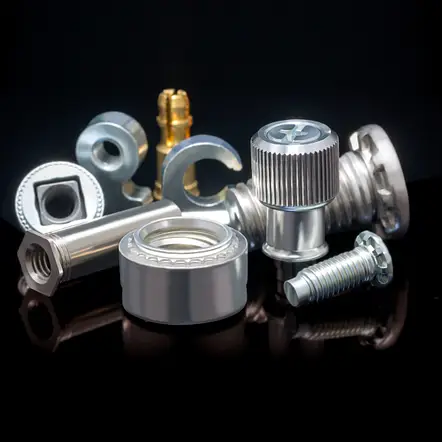
When a sheet metal drawing arrives in our engineering department, hardware callouts are usually already locked into the print. Design engineers often select fasteners early in the CAD modeling process without evaluating how the part will move through the shop floor. While specifying PEM fasteners (self-clinching hardware) is standard practice for thin sheet metal assemblies, defaulting to them on every hole isn't always the fastest or most cost-effective path to a finished part.
Our engineering team evaluates every hardware callout through the lens of Design for Manufacturability (DFM). Selecting hardware is about optimizing total manufacturing time, part geometry, and joint performance. Evaluating when to use PEM fasteners, when to switch to direct tapping or welding, and how hardware installation fits into precision sheet metal fabrication is critical to building better parts at a lower cost.
The Purpose of PEM Hardware in a Sheet Metal Assembly
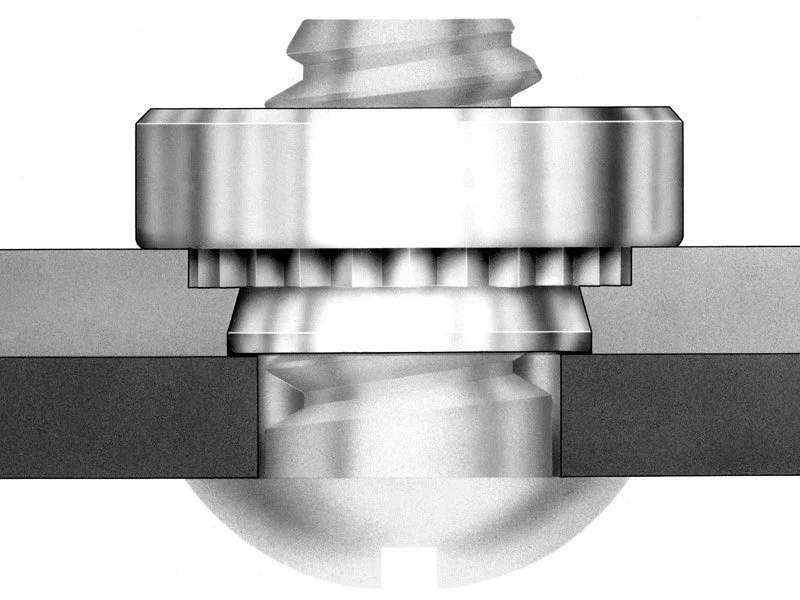
Self-clinching fasteners operate through a cold-flow mechanical process. When pressed into a ductile metal sheet under controlled pressure, the fastener displaces host material around the mounting hole, forcing it to cold-flow into an engineered undercut on the fastener shank. A serrated clinching ring or knurl locks into the sheet, preventing the fastener from rotating or twisting out under load. This creates permanent, high-strength machine threads in metal panels that would otherwise be far too thin to tap.
While "PEM" is a brand name, much like "Channel Lock" is for tongue-and-groove pliers or "Coke" is for cola, it has become universal slang across precision fabrication for press-fit hardware. The overall category includes:
PEM Nuts: Internal machine threads pressed flush into a sheet.
PEM Studs: Threaded pins protruding from a panel to mount mating components quickly.
Standoffs: Threaded or unthreaded spacers used to stack circuit boards or sub-assemblies.
Captive Screws & Panel Fasteners: Spring-loaded hardware that remains permanently attached to access panels or enclosure doors.
Wire Tie Mounts & Keyhole Standoffs: Non-threaded hardware designed for fast cable harness routing and slide-on panel mounting.
To explore mechanical variations of self-clinching hardware, read our overview of PEM hardware types and installation considerations.
The Conditions That Make PEM Hardware the Right Specification
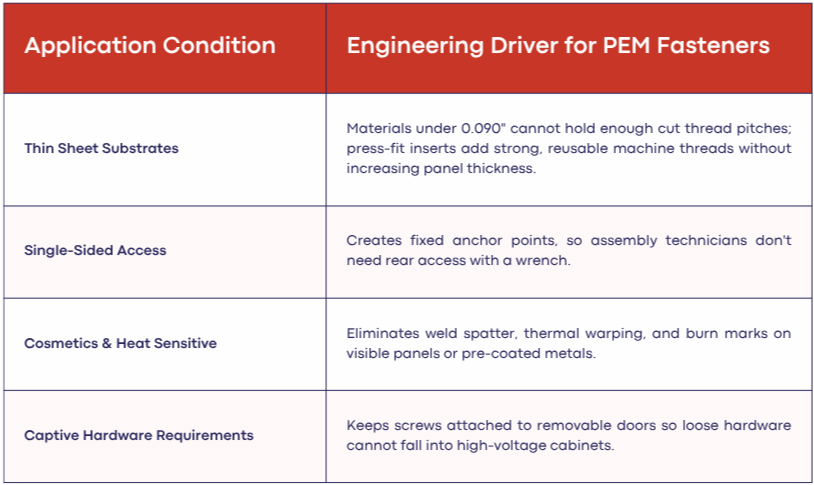
Self-clinching hardware excels across multiple industries, including medical devices, aerospace ground support, telecommunications, and industrial electronics enclosures. Four specific engineering conditions make specifying self-clinching fasteners the clear winner:
The Geometry Has to Cooperate (PEM Fastener Design Guidelines)
Even when self-clinching hardware is ideal on paper, part geometry dictates whether installation is physically possible on the shop floor. Following core PEM fastener design guidelines prevents quality issues during production.
Pre-Pierced Hole Size (The #1 Quality Factor)
The single most common cause of hardware failure in the field is an incorrect mounting hole diameter cut into the flat pattern.
"Depending on the specific PEM hardware you’re installing, your pre-pierced hole needs to be a very specific dimension," states Froemming. "A lot of times we see customer drawings where the through-hole isn't sized properly for the hardware code. If we blindly manufactured the part to print, the nuts wouldn't hold. Verifying pre-pierced hole sizes against the hardware manufacturer's specs is the first thing our engineering team checks."
Edge Distance and Bend Proximity
Pressing PEM hardware displaces metal under substantial tonnage. If a mounting hole sits too close to a free edge, the expanding metal bulges the outer profile. If placed too close to a bend line, the insertion press anvil will interfere with the formed flange, or the installation pressure will deform the bend radius.
Press and Anvil Tool Clearance
A part must physically fit inside an insertion press throat. Complex 3D box shapes, narrow U-channels, or tight return flanges can block anvil access, requiring custom extended tooling or a design adjustment before forming.
Laser Cutting Synergy
Modern fiber lasers have changed how hardware preparation is integrated into sheet metal workflows.
"Traditional sheet metal relied on turret punch presses with 3D fab tooling to extrude or tap holes," says Froemming. "With lasers, we can cut complex organic shapes and precise pre-pierced hardware holes in one pass. Then the part goes straight to the press brake and over to our hardware setters. Installing a PEM nut takes 15 seconds, compared to over a minute per hole for traditional machine-shop tapping setups."
Material Pairing and Hardness Rules
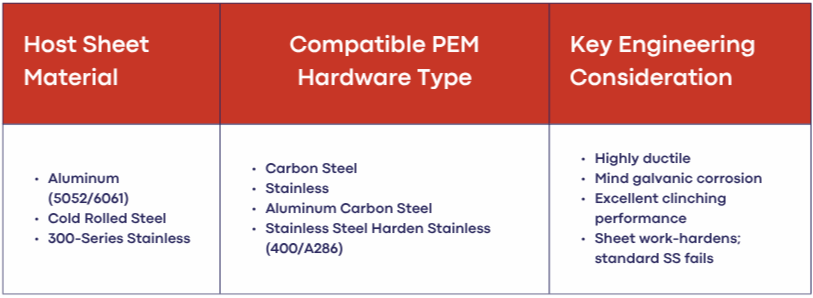
A fundamental law of self-clinching hardware is that the host sheet metal must be softer than the fastener. During installation, the host material must yield and cold-flow into the fastener's undercut. If the sheet metal is harder than the fastener, the shank crushes without clinching.
Aluminum Panels: Aluminum is soft and ductile, making it easy to clinch. However, in outdoor or high-humidity environments, pairing bare steel studs with aluminum panels can induce galvanic corrosion. Stainless steel or aluminum hardware prevents galvanic pairing issues.
Steel Panels: Standard cold-rolled steel pairs seamlessly with case-hardened carbon steel hardware.
Stainless Steel Panels: Stainless steel work-hardens rapidly. Standard 300-series stainless steel fasteners cannot be installed into 300-series stainless steel sheets because both materials share similar hardness levels. For stainless panels, engineers must specify specialty hard-stainless fasteners (such as 400-series or precipitation-hardened stainless hardware) engineered specifically for stainless mounting.
When We Recommend a Different Approach
We evaluate whether a design change will lower total unit cost or improve structural performance. There are distinct scenarios where we steer customers away from self-clinching PEM inserts:
High-Volume Identical Threads on a Single Panel: When a part requires dozens or hundreds of identical thread features, manual or semi-automated press insertion labor can exceed machining time. "We run a part that is 3 inches wide by 5 feet long with roughly 180 tapped holes," shares Froemming. " In that specific scenario, pressing 180 individual PEM nuts by hand is inefficient. Running the panel through an automated multi-spindle tapping machine is significantly faster and more cost-effective." To evaluate thread-cutting alternatives, see our guide on four common methods for threading holes in sheet metal.
Thick Gauge Plate: If sheet metal is thick enough to support full structural thread engagement (typically 0.125" and above depending on thread size), direct tapping or CNC thread milling avoids hardware purchasing costs entirely.
High Axial Pull-Out or Shock Loads: While self-clinching fasteners offer high push-out and torque-out resistance, severe axial loads or heavy dynamic vibration profiles can pull a clinched fastener out of thin material. In structural applications, projection weld nuts or threaded structural studs provide higher pull-out strength.
Field-Installed Blind Attachments: If hardware must be installed after an enclosure is fully welded or assembled in the field where access is restricted to one side, blind rivet nuts (rivnuts) or threaded inserts are often the practical choice. Learn more about structural joining options in our review of sheet metal assembly techniques and applications.
Substrates That Exceed Hardness Limits: Heat-treated spring steels or fully hard alloys crush self-clinching hardware upon press impact.
How Finishing Sequence and Volume Drive Real Costs
The interaction between hardware installation and finishing operations (plating, powder coating, anodizing) is a significant cost driver.
Pre-Finish vs. Post-Finish Installation
The standard approach is to press hardware before finishing so the entire assembly receives a uniform coating. However, chemical plating baths can react aggressively with certain fasteners.
"Certain plating processes will turn zinc-plated or specialty hardware black if it's pressed into the part prior to finish due to chemical reactions," Froemming explains. "Installing hardware after finish prevents damage, but doing it post-finish requires careful handling so you don't scratch the fresh powder coat or plating."
To solve this, HPM created standardized test coupons across our plating processes. By testing hardware reactions in advance with our finishing partners, we identify which fastener/finish combinations allow pre-finish installation, saving our customers significant labor and masking costs.
Equipment Capabilities and Inventory Support
Hardware installation cost is driven by setup time, handling, and stroke speed. HPM continues to build its fleet of hardware insertion presses, and will house 16 Haeger hardware insertion presses as of October 2026, including automated systems that bowl-feed hardware directly to the press anvil. Automated feeding cuts handling time in half for high-volume runs.
Furthermore, HPM maintains a massive in-house inventory of standard and specialty press hardware. For quick-turn prototyping, OEMs do not have to wait weeks for hardware shipments. We pull from stock and press immediately. Explore our full hardware installation capabilities.
Partnering with Herold Precision Metals for Hardware Optimization
Navigating hardware selection comes down to balancing part mix, volume, and processing efficiency. If you have high-mix, low-volume thread needs, PEM hardware is almost always the best solution. Conversely, for high-volume, low-mix production runs, an automated turret press and traditional tapping methods are often recommended to keep unit costs low. And if you aren't sure which path makes the most sense for your design, give HPM a call. Our engineering team is always ready to evaluate your print.
HPM is a proactive partner dedicated to eliminating production headaches before they happen. From leveraging our 16 Haeger presses (including automated units) and vast hardware inventory for quick-turn prototypes, to utilizing our deep engineering knowledge of pre-pierced hole tolerances and plating reactions, we work directly with you to ensure every fastener is specified correctly, installed cleanly, and built for maximum performance.
When preparing your files for review:
Provide 3D CAD Models (STEP/Solid Works alongside PDF Prints: Allows our DFM team to check hole sizes, flange clearances, and press anvil access.
Flag Flexible Callouts: Note if you are open to replacing machined tapped holes with PEM nuts (or vice versa) to unlock manufacturing efficiencies.
Specify Coating Requirements Upfront: Helps us determine the ideal hardware material and installation sequence early in the quote stage.
Ready to optimize your sheet metal assemblies? Request a quote today to have our engineering team review your hardware callouts.
Frequently Asked Questions About PEM Fasteners
-
Most standard self-clinching fasteners require a minimum sheet thickness of 0.030 inches (0.8 mm). However, specialty thin-sheet hardware lines can be installed into materials as thin as 0.020 inches (0.5 mm).
-
A PEM nut is pressed mechanically into a pre-pierced hole, cold-flowing the host metal to lock it in place without heat. A weld nut uses localized electric resistance welding to fuse the fastener to the sheet, which introduces thermal stress and requires unplated, weldable metal.
-
Yes, but the fastener must be harder than the stainless steel panel. Standard 300-series stainless fasteners cannot be installed into 300-series stainless panels. Specialty precipitation-hardened, or 400-series stainless hardware must be specified.
-
If the mounting hole is oversized, there is insufficient host material to cold-flow into the fastener's undercut. This results in poor push-out strength, spin-outs under torque, or hardware falling out completely.
-
Installing hardware before powder coating is faster and eliminates post-finish handling. However, you must mask or plug threads to prevent paint ingress, and certain chemical pre-treatment washes can discolor specific plated hardware.
