
Inside HPM's Standing Library of Common Turret Punch Tooling
When a high-mix product catalog moves to a new fabricator, the first question in the sourcing review is usually about tooling. What will it cost to get these parts running, and how long before the first ones ship? Those two numbers, the up-front investment and the lead time to first article, are what make or break a supplier transition on paper.
For sheet metal parts that run on a turret punch, the answer tends to be better than most procurement teams expect, because the common turret punch tooling your catalog needs is already racked and ready on our floor. We run a large library of Wilson Tool thick-turret tooling across seven turret punch presses, built up over more than a decade of high-mix work, which means the holes, slots, knockouts, louvers, and formed features on the majority of prints map to tools we already own. There is no per-part die to buy before we can quote, nothing to amortize over a production run, and no tooling lead time standing between an approved program and a first article. Every part also moves through an ISO 9001:2015 certified quality system.
This post walks through what the library contains, why running on it keeps a catalog transfer off your capital budget, and how standardized geometry shortens onboarding from prototype through repeat production.
How Deep Our Common Tool Library Runs
Our seven turret punch presses run multi-station, auto-indexing turrets, several of them carrying 40 or more stations and up to 48 on our largest, and a single program can call dozens of different tools in one cycle without an operator stopping to change a setup. Behind those stations sits an inventory we've built across more than thirteen years of high-mix production, spanning standard, special, and forming tooling.
That depth is what turns into a procurement advantage. The deeper the standing library runs, the larger the share of any incoming catalog that lands on tools we already own, which is exactly what shortens onboarding and keeps tooling off your quote. A shop with a thin tool crib quotes new geometry as new tooling. A shop with a deep one absorbs most of that geometry into what's already on the rack.
The common shapes are all stocked across a wide range of sizes:

Round
Rectangular
Obround, square
Double-D
Corner radius
Beyond the basics, our tool list includes the special and forming tools that handle features most prints call out somewhere:
Louvers for airflow vents in enclosures and chassis
Embosses and coining for stiffening ribs, standoffs, and flush hardware
Electrical knockouts for conduit and connector openings
Countersinks for flush-head fasteners
Hinges formed directly into the part
Thread form and in-station tapping for threaded holes
Cluster tools that set a full hole pattern in a single stroke
Special shapes for openings that a standard round or rectangular punch won't make
Part marking, deburring, and forming tools
What A Catalog Transfer Keeps Off Your Capital Budget
It helps to separate the two kinds of tooling here because they have very different cost structures, and sourcing teams often price them as if they were the same thing.
Dedicated hard tooling, the kind a progressive die requires, is built for one part. It carries an upfront cost, often in the thousands or tens of thousands of dollars, and that cost only makes sense once it is amortized over enough volume to bring the per-part price down. For a high-mix catalog with modest quantities per line item, dedicated tooling rarely pencils out. The math that justifies a stamping die doesn’t make sense when you spread it across a hundred low-volume part numbers, and any tooling you do commit to becomes a stranded cost the day a product line changes or sunsets.
Common turret tooling works on a different model. The tools are general-purpose and shared across every job that needs that geometry. A quarter-inch round punch makes a quarter-inch hole, whether the part is a medical bracket or a server rail, so the cost of owning that tool is spread across years of work rather than charged to your program. When your prints use common geometry, the tooling they need is already paid for and already sitting in the turret.
For a catalog transfer, running on our standing library takes a familiar set of capital hurdles off the table:
A tooling purchase that has to clear approval before any parts can run
Amortization that only works once a part hits high enough volume
Tooling that sits idle or gets written off when a product line changes or ends
Tooling lead time sitting on the critical path to the first article
What remains on a transferred catalog is the setup work itself, mostly programming, nesting, and first-article inspection. That work is measured in engineering hours instead of capital overlay. Standardizing hole sizes and feature callouts across your catalog further reduces costs because parts in a family share programs and tooling and run back-to-back with fewer changeovers. The big-ticket item that usually drives a transition budget, the tooling, is the one that mostly doesn't apply.
Forming And Tapping In The Same Operation
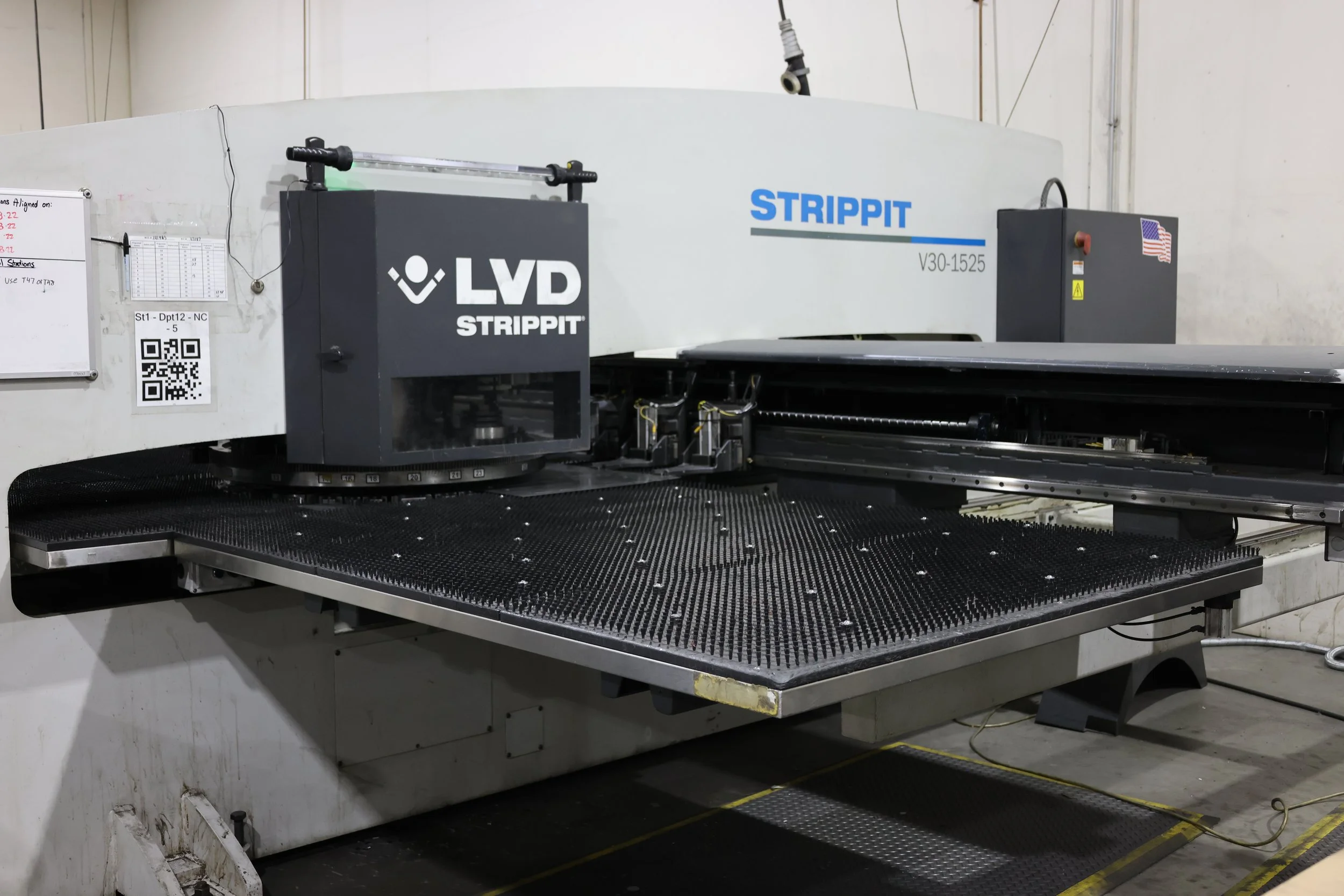
Several of our turret presses are set up for hydraulic forming and tapping in-station. A feature such as a louver, an emboss, a countersink, or a light-gauge thread is formed in the same operation that punches the blank, while the part is still held in the press.
Every time a part leaves one machine and moves to another, it’s handled, refitted, and inspected again, and each move adds cost and increases the risk of a defect. Forming in the turret keeps the part in a single setup, which is where much of the cost quietly comes out of a job, and lead time gets shorter. A part that might otherwise require a punching operation, a separate forming step, and a tapping station can run start to finish in one cycle on our turret punching line.
We have 7 turret punch presses, 28 press brakes, 5 laser centers, and Haeger hardware insertion on our floor. When a feature is better served off the turret, the press brake or machining cell is only a few steps away and under the same PO.
Onboarding A High-Mix Catalog
Bringing a catalog of existing parts to a new fabricator is a transfer, and transfers live or die on how quickly parts go from print to first article. The standing tooling library is what makes that fast for punched parts.
When your prints arrive, our engineering team reviews each one against the tooling already in-house and flags which features punch or form on existing tools, which belong in a secondary operation, and where a small design tweak would save money without touching fit or function. For most parts in a typical sheet metal catalog, that review confirms the geometry runs on tools we already stock, and the part moves straight into programming.
The same standing library serves a prototype and a repeat production run equally well because the tooling for both is already on the floor. There's no separate tooling spend to clear when a part graduates from a handful of prototypes to a scheduled production quantity, which is what lets a program ramp without a second capital conversation partway through.
When a part does call for a shape we don't carry, we add the tool. That's a routine part of onboarding, and it works differently from building a dedicated die, because the new tool then joins the library and serves every future job that needs it. The program around the part doesn't get rebuilt to accommodate custom tooling, and the rest of the catalog keeps moving while that one tool comes in.
This is the work our new product introduction process is built around: taking a body of existing parts, confirming the tooling and operations up front, and getting a quote back with the path to production already worked out. The fewer surprises in that first pass, the faster the catalog ships.
The Materials And Tolerances Behind The Library
Tooling selection varies with material and thickness, so coverage is only useful if it supports the metals your catalog uses. Our common tooling runs cold-rolled and hot-rolled steel, stainless, and aluminum across a range of gauges. On the turret, we typically punch up to 0.134 inch (10-gauge) in steel, 0.125 inch in aluminum, and 0.060 inch in stainless steel, depending on feature geometry and tooling.
Industries This Tooling Serves
The tooling on our floor produces parts across the full range of industries we serve, from enclosures and chassis for electronics and data center equipment to precision components for medical, lab, and test equipment, as well as government work. Each one brings its own tolerances, materials, and finishes, and the depth of the library lets us meet them without sending you out to find a second shop for features one supplier can't form.
A Catalog Transfer Doesn’t Have To Hurt Your Budget or Timeline
The short version is that a deep, standing tooling library changes the economics of moving a high-mix catalog. Because most common geometry already runs on the Wilson Tool thick-turret tooling racked across our seven presses, the tooling that usually drives a transition budget mostly stays off it, and parts that pass DFM review move into programming without waiting on a die to be built. In-station forming and tapping keep features in a single setup, and the whole thing runs under an ISO 9001:2015 system with a clean audit record.
If you want to see how much of your own catalog that covers, the next step is a small one. Request the full tooling lineup to check your prints against what we already stock, or take a closer look at how the presses run.
