
When a shipment of fabricated parts lands on your dock, someone on your quality team will ask if these parts were made from the material called out on the print. A dimensional check can confirm the geometry, though it can't tell you whether a bracket was cut from the 5052 aluminum your engineer specified or from 6061. Material certifications and lot traceability can. The material cert documents what the metal is, and lot traceability connects that document to the parts in your hands. We track material as part of our ISO 9001:2015 certified quality program, from the moment it comes off the truck until the finished part ships.
We sat down with Scott Neumann, our Vice President of Operations, to walk through how that works on our shop floor and what it means for the parts you receive.
What a Material Cert Tells You
Material certs come from the vendor we buy the metal from. Each one records the heat lot, lot number, material grade, and other details that tie the metal back to where it was produced. You'll hear these documents called material certs, mill certs, or certificates of conformance (C of C). Some sources draw technical distinctions between those terms, though in day-to-day fabrication they all do the same job.
Buyers often ask how lot numbers and heat numbers relate to each other. Both appear on the cert. When materials arrive at our facility, we record exactly what we received, and that record becomes the reference point for the parts made from that metal.
Material Has to Match the Print Before Production Starts

A cert can only prove a part matches the print if the material callout on the print is correct to begin with. That's why new jobs and revisions start with a review by our engineering team.
"Every new job or rev change job is going to run through our engineering team and be reviewed," Neumann says. That includes a complete part redesign, and it also includes something as small as adding or updating a label on a bill of materials. Every revision gets the same review.
One of the most common issues our engineers catch is a material callout pulled from the wrong set of standards. Sheet metal and machined block material don't always follow the same standards, and a designer will sometimes specify a block material assuming it matches the sheet metal version. When we spot that, our engineering or account management team reaches out with the equivalent sheet metal. From there, the customer can issue a permanent deviation or update the print to allow either material.
All of this has to happen before we process the job. "Our quality won't sign it off and send it out the door if material doesn't match print," Neumann says.
Resolving any discrepancies during engineering review keeps the job on schedule and makes sure the paperwork that ships with your parts lines up with your drawing.
How Lot Traceability Works From the Receiving Dock
Lot traceability starts when sheet metal comes off the truck. Our team inspects each delivery to confirm it matches what we ordered, down to details like a 48-by-120-inch sheet size. Once it checks out, the material is inventoried into our system along with the vendor's information, including the purchase order and receiver. All of the paper documents that came with the shipment are scanned and attached to that material record.
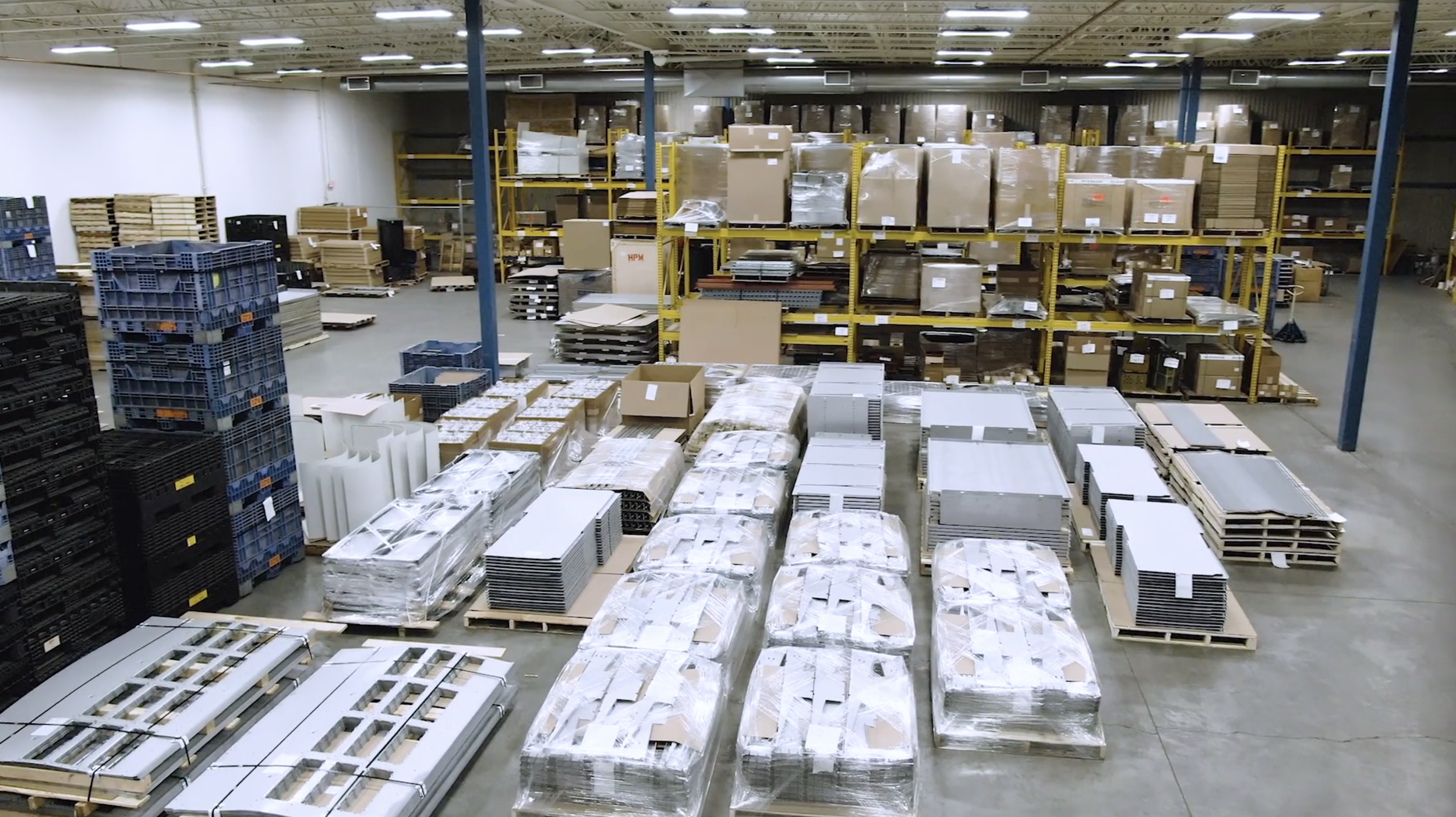
Each lot also gets a QR code and is scanned in and out of inventory each time it moves. That holds whether the material goes into general stock or was bought for one job. Our turret punch work is a good example of the second case, since we often buy blanks already cut to size.
Because the material record follows the metal into production, our quality team can pull the mill certs and send them whenever a customer needs them. We record that information whether or not the customer asked for certs.
"If anybody needs to see it, even if somebody doesn't require a C of C or anything, we can tell them what material we use," Neumann says.
That record has come in handy. In a few cases where certs were missed on a shipment, customers reached back afterward, and we were able to provide the information from our system.
Why We Keep Lots Separate on Formed Parts
Traceability also shapes how we schedule material. Our practice is to avoid mixing lots within a job. If a job calls for 20 sheets and we have 10 from one lot on hand, those 10 may stay on the shelf for the next job instead of being combined with a second lot.
"If it gets formed or other processing in our building, we try not to mix the lots because that can create problems," Neumann says.
Flat parts are the exception. When a part is only laser cut before it ships, or laser cut and painted, mixing lots has no effect on the finished part. Parts that are formed or go through other in-house processing stay on a single lot.
Traceability Through Outside Finishing and Hardware
Some parts leave our building for plating or painting through our finishing partners. Their traceability stays intact the whole time, because the parts remain under our work order.
How parts go out depends on the job. An order of 250 parts might go to the plater all at once or in two batches of 125, depending on when production wraps up and when the customer needs them. A large part, around 60 by 48 inches, might go out 10 at a time if that's all the finisher has room to handle. However the batches are split, the lot traceability stays with us.
"It's all controlled by us because we're cutting all the material, manufacturing it, and whatever process they're doing," Neumann says. When a job requires it, the finisher provides its own certificate of conformance for the process it performed.
PEM hardware runs through the same system as our sheet metal. Each bag gets a QR code and is scanned in and out of inventory as it's issued to jobs. We know which hardware lots went into a work order and how much of each was used. If two lots of the same fastener went into one work order, we can identify both lots and the quantity from each. Because the fasteners themselves carry no differentiating marks, we may not be able to say which individual part received which lot. If you're still deciding on hardware for a design, our engineers explain when PEM fasteners make sense.
How Cert Requirements Vary by Industry

Each customer decides what documentation they need, and we provide what they request. That matches how ISO 9001 approaches traceability. Clause 8.5.2 calls for traceability records when traceability is a requirement, such as when a customer or regulation calls for it.
The certs themselves don't change from one industry to another. The C of Cs that come with our stock material are based on the material, whatever market the finished part serves. What changes is how much of that documentation each customer wants to see.
Military, government, and medical customers sit at the high end. They require a C of C with every order and don't allow a process deviation of any kind without written approval up front. Electronics and data center customers tend to be less stringent. Plenty of other customers request a C of C with the first order and stop asking once they've confirmed the material is right.
How We Keep Material Records Tight
The material cert gives your inspector the paperwork, and lot traceability connects that paperwork to the part on the bench. Both run through our barcode system from engineering review to the finished part.
"We try to keep it as tight as we can. Everything's on a barcode system. Everything is issued to the job as we do it," Neumann says.
Want to see how material traceability fits into our broader quality system? Learn more about HPM quality assurance, or request a quote to start your next project with our engineering team.
