
The new product introduction process decides whether a part that looks right on screen becomes a part that ships on time, holds tolerance, and stays affordable at volume. New product introduction, usually shortened to NPI, is a structured framework that guides a component or assembly from definition through design review, prototyping, validation, and launch. The team confirms the design can be built, proves it on first parts, and then confirms it can be repeated at volume.
NPI covers everything from the day a customer hands over a design to the day that design runs as a repeatable production job. Most of the risk in a new product lives in that stretch because quality and delivery suffer when small details aren’t identified and addressed proactively. That’s why at HPM, we bring our engineers, account managers, and operations team into every project early.
Our NPI process follows a defined 12-step workflow to help mitigate this risk. Here’s how it works, what it changes for customers, and how it can shorten the timeline.
NPI vs. NPD: Understanding the Difference
It is common to hear NPI used interchangeably with new product development (NPD), but they represent distinct phases:
New Product Development (NPD) focuses on initial concept generation, market research, industrial design, and core functional testing. The OEM’s internal product development and engineering teams typically lead NPD.
New Product Introduction (NPI) takes the vetted product design and defines the manufacturing parameters, tooling, operational routing, quality controls, and supply chain required to build that product consistently, cost-effectively, and at scale.
How Our New Production Introduction Process Works
Every NPI project begins with a relationship. Matt Herold, New Product Manager, leads the internal kickoff for new programs, saying, “It all starts with a good relationship upfront between our account manager and the customer, going through what they want, what they need, and when they need it.”
Once the purchase order arrives, it goes directly to Matt. His job is to bring engineering, account management, and operations together and identify bottlenecks that could create long-term issues for the customer. From there, the work follows 12 steps.
The HPM Process: New Product Introduction
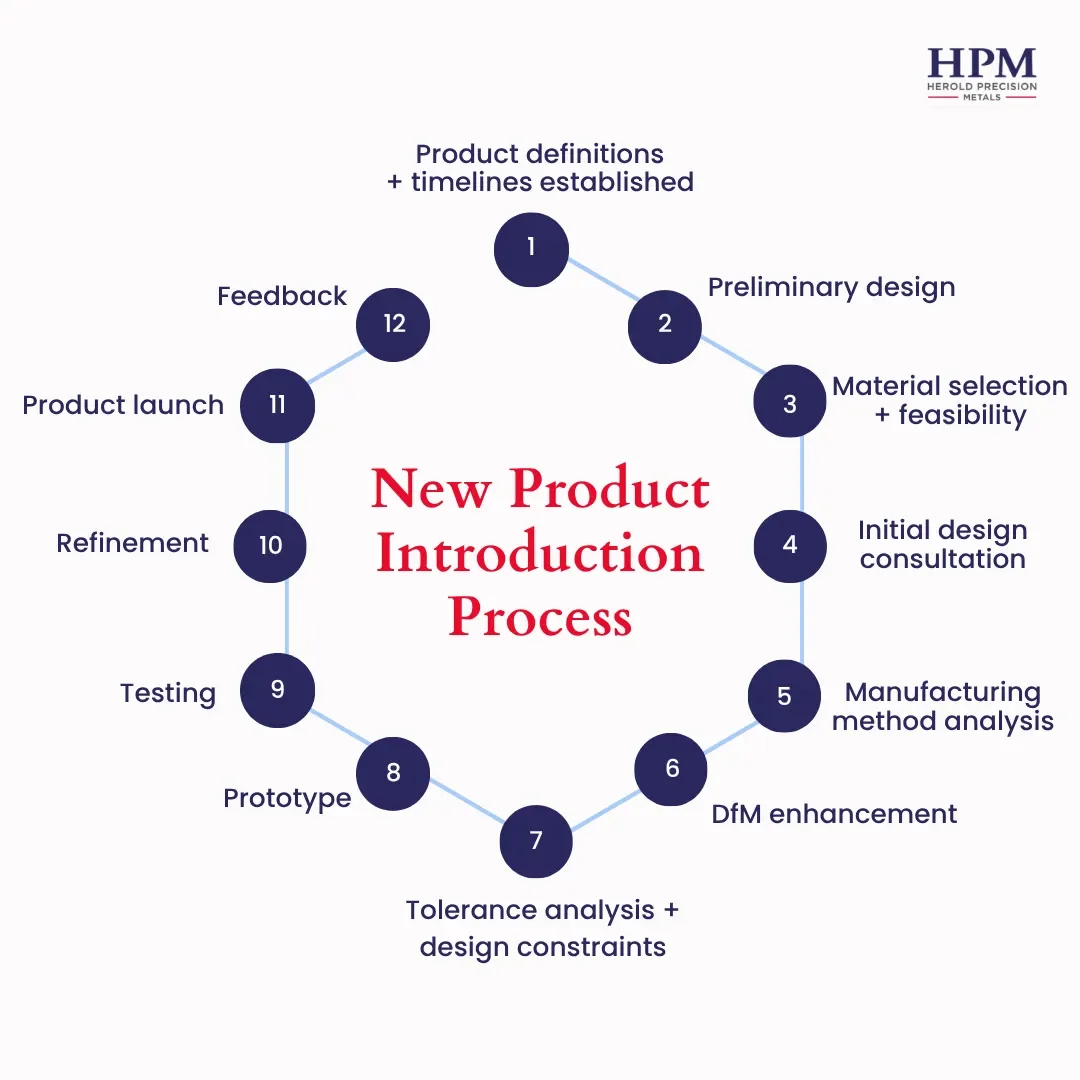
1. Product definition and timelines established
2. Preliminary design
3. Material selection and feasibility
4. Initial design consultation
5. Manufacturing method analysis
6. Design for manufacturing enhancement
7. Tolerance analysis and design constraints
8. Prototype
9. Testing
10. Refinement
11. Production Launch
12. Feedback
Defining the Product & Confirming Feasibility (steps 1 through 3)
The first three steps establish product definition and timelines, review the preliminary design, and complete material selection and feasibility. Matt considers our vendor and supplier network one of our biggest competitive advantages. We’ve worked with our materials suppliers for nearly 30 years and with our tool and die makers since we founded the company in 1997. Matt explains, “Our engineering team has the unique advantage of being able to reach out to them for suggestions on how to improve things straight away during the pre-production stages that we will use in production.”
Design Consultation & DFM (steps 4 through 7)
Steps four through seven cover the initial design consultation, manufacturing method analysis, design for manufacturing (DFM) enhancement, and tolerance analysis with design constraints. These are some of the most important conversations on every new project. Matt explains, “DFM at HPM is one of our specialties and makes us unique. It’s our strategic advantage when customers walk in the door, especially for new projects. We invite that.” The goal is to improve delivery and quality while lowering the price by making the part better. Our guide to design for manufacturability goes deeper on this stage.
Bob Borgerding, Vice President of Sales and Marketing, explains why early participation matters. “A lot of engineers can draw anything on the CAD system. Some have more or less experience with sheet metal, but if they’re willing to let us participate, we can bring our industry and production experience to the forefront. What it does is allow them to draw things we can manufacture, and it allows us to manufacture that product very quickly.”
We can sometimes combine a multi-piece design into a single piece. Where a design calls for costly processes like welding and grinding, we can often offer alternatives such as riveted construction or structural adhesives that deliver the same fit, form, and function.
Knowing how the part is used helps make those recommendations better. We sometimes look at parts, but sharing the purpose of the parts, how they're used, and whether they're visible helps us with design recommendations.
Bob explains, “What Matt tries to do is assemble the team to get all the right heads in the room at the same time to discuss all the nuances and work any problems out proactively. So when it gets released out to the shop floor, every little detail is established, and we can just focus on executing.”
Prototype, Testing, & Refinement (steps 8 through 10)
Steps eight through ten take the design through prototyping, testing, and refinement. Production stays in view the whole time. “You might have been able to prototype something once, but if you had to make a thousand of them, it gets hard,” Bob says. “We always have production in mind when we’re going through the prototyping and NPI process. We have our eyes set on scaling at the level the customer wants.”
Customer sign-off is the gate between this stage and full production. This is often called first article inspection. Here, it means the customer reviews the first parts and the data behind them before we ramp up production. We also meet with the customer after they receive those first parts, as sometimes the parts reveal something new. A few adjustments at this point can improve every run that follows.
Production Launch & The Feedback Loop (steps 11 and 12)
Steps eleven and twelve are production launch and feedback. “We meet after the parts are produced to dot any i’s, cross any t’s, and make any adjustments that are necessary before the next run happens,” Bob says. When a new finding comes up, we document it and incorporate it into the next production run, so nobody has to learn the same lesson twice.
What Makes Our NPI Manufacturing Process Different
We follow the processes we’ve developed over decades of experience. “We do this because it delivers the best result for the customer and for HPM,” said Bob.
1. Direct Engineer-to-Engineer Communication
We bring customer engineers directly together with our own engineers, and we encourage program managers to ask hard technical questions early. Matt says direct engineering collaboration dramatically speeds up timelines. Tolerance and future quality issues get resolved before we even have the parts.
2. 30+ Year Vendor & Supplier Network
Our long-standing relationships with materials suppliers and tool-and-die makers give our engineering team a unique advantage when seeking pre-production improvements. This includes tooling and finishing options.
3. Practical Shop-Floor Expertise
The people who guide a project through NPI also know the shop. Matt pointed out that “90% of our front office has spent some time on the floor or has dealt with our equipment.” This hands-on background helps make sure DFM suggestions and production plans reflect actual production dynamics and machine capabilities.
4. Built to Scale for Rapid Growth Sectors
Scale is where the upfront work shows. Data center and AI programs are a recent example. Matt says that sector went from a very minute percentage of business to exploding dramatically, and without the kickoff meetings built into NPI, we couldn’t have ramped up production to match demand. Without upfront work on tolerancing, quality measurements, and DFM meetings, it would have been a lot harder. “It’d be like telling a train that is accelerating that it needs to stop because it needs better wheels.”
5. Documented Feedback Loop
After parts are produced, the same team meets to review what we learned and document any new findings before the next run, so each run builds on the last. This critical step cannot be overlooked.
How Long Does the New Production Introduction Process Take?
The NPI timeline depends heavily on the specific part or assembly. As Matt points out, "It very much varies part to part because everything is unique that we do." Some jobs involve a single part, while others are complex assemblies with up to 100 different components.
While physical complexity dictates part of the schedule, what we can control is how early the customer hears what is coming. Matt shares information with the customer as early as possible so the account manager can prepare them for what higher-volume production will look like.
Sometimes, scaling to high volumes requires dedicated tooling. If meeting a customer’s volume forecast calls for investing in a new tool, the conversation belongs in NPI.
Warning Signs That a New Product Introduction Is Heading for Delays
Recognizing red flags early prevents small design oversights from morphing into schedule-draining production delays.
Matt explains that NPI red flags are mostly technical and usually trace back to quality expectations, especially when different quality requirements stack up until they become redundant. Catching and simplifying these requirements during early DFM and tolerance analysis is far easier than untangling them after physical parts exist.
Timing is the other major hurdle. "Sometimes you get too far down the path, and nobody wants to go back and rework the design," Bob cautions. In regulated markets like medical device manufacturing, we often see designs that have clear opportunities for structural or cost improvements. However, once an enclosure or assembly has gone through formal testing and regulatory approval, reworking the print is like pulling teeth. That is why we put design review and tolerance analysis ahead of prototyping in NPI collaboration. The earlier, the better.
How Customers Can Shorten the NPI Timeline
To accelerate the quote-to-launch schedule and minimize friction during product introduction, this is what we recommend to customers:
Send everything, and send it early: Share all relevant documents and CAD files as soon as possible. Instead of sending only individual sheet metal components, provide the full assembly model. When we can see the electrical, electronic, and electromechanical components inside an enclosure, we often discover design optimizations that aren't self-evident from sheet metal prints alone. As Bob notes, "There’s never a downside to sharing that additional information with us."
Bring your engineers, and ask the hard questions: Direct engineering collaboration speeds up the process significantly. Matt advises, "Don’t be afraid to have the hard questions, because the hard questions are going to make the project a lot easier down the road." When our fabrication engineers work directly with your design team, tolerance stack-up issues surface and get resolved fast. If you are launching a part with a contract manufacturer for the first time, essential questions to ask upfront include the following:
Who will participate in the NPI kickoff meeting?
How will DFM recommendations reach your engineering team?
Who holds final authority to sign off before production release?
How are findings from the initial build documented for future runs?
Engage early and often: Bob tells customers that the earlier we get involved, the faster it goes. Early meetings can seem like they take a little time, but they give you “a much higher probability of success.” His advice is simple. “Engage us early and often.”
Partner with Herold Precision Metals for Your Next Product Launch
If you have a new part, assembly, or hardware program on the horizon, choosing a precision sheet metal partner with a developed, process-driven NPI workflow is the best way to safeguard your schedule and budget.
Learn more about our specialized new product introduction services.
Ready to collaborate? Request a quote today to start the conversation directly with our engineering team.
